
The short version
- Start with your board: what does the year need, and what is the money for?
- Count the families selling, then work backward to one goal per seller.
- Not too easy. A goal that’s easy to reach becomes a ceiling.
Why an easy goal backfires
A goal gives a kid something to aim at, and it helps. But we’ve seen it in the numbers: when the goal is easy, kids reach it and stop. The neighbors they didn’t get to never get asked. Next year those customers show up on your lapsed customer list, and the list climbs fast.
So it’s a balance. You want a goal that stretches a little and still feels fair.
Work backward from your board
- 1.Ask your board for the year’s number. What does the group need to raise, and what is it for? Lower costs for families? A great season for the kids?
- 2.Count the families selling. Not the whole roster. The families who will really sell.
- 3.Divide, then check it against your product. If you make about $5 on each item, a $300 goal is 60 items. Is that doable for a kid?
- 4.If it’s too big, change the plan, not the kids. Try a product with more profit per item, a longer list of past customers, or a smaller target.
- 5.Share one number per seller. In dollars or in items, whichever your kids picture better.
Copy this
The goal, for the kickoff
This year each seller’s goal is [goal]. That’s what it takes to [what it pays for], and it keeps every family’s out-of-pocket cost down. You’ve got this!
When a seller reaches it
[Seller] hit their goal! Thank you. Every order from here helps the whole team.
A quick example
A dance team’s board needed $9,000 for competition fees, so families would pay less out of pocket. Thirty families were selling cookie dough at about $6 profit a tub. That’s $300 per seller, or 50 tubs. Last year most sellers had sold around 40, so 50 was a stretch, but a fair one, and it kept kids knocking after the first easy weekend.
How The Order Buddy handles it
On paper, you find out who reached the goal when the forms come back. With The Order Buddy, you set one goal per seller on the event, in dollars or in items, and your seller list shows how far each one has to go, all through the sale.
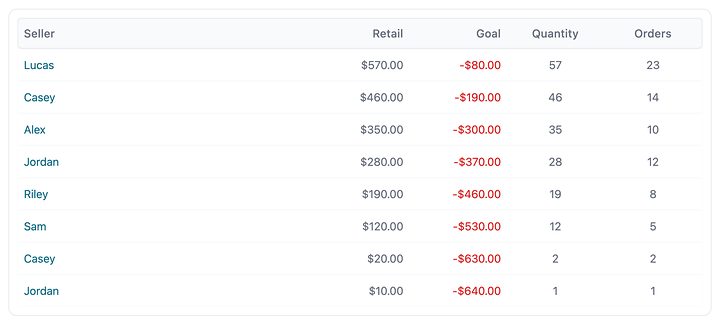
Families see their own sales on their dashboard, so they always know where they stand.
After the sale, Insights shows how seller totals spread out around the goal. If a lot of sellers stopped right at it, the goal was acting as a ceiling, and next year’s can go up.
What it won’t do is set the goal for you. That conversation belongs with your board.
Want to see it on your own sale? , or read straight answers on how it works.
Your checklist
- The year’s number and its purpose, from the board
- Families selling, counted
- One goal per seller, checked against your product
- Not so easy it becomes a ceiling
- Goal shared at the kickoff
All nine steps
- 1.Set three dates, and treat the close as a hard stop
- 2.Pick one coordinator, and make it obvious who it is
- 3.Give every seller a goal they can see
- 4.Kick off with one meeting and one link
- 5.Decide how you’ll take payment, and say it once
- 6.Check in at the halfway mark
- 7.Close on time and send one clean supplier order
- 8.Make pickup day boring
- 9.Wrap up and hand next year a head start