
The short version
- One place, one pickup window of two to three hours. Big group? Split it over two days.
- Count every case before the driver leaves.
- Keep anything frozen cold, and give leftovers a deadline and a home.
The week before, ask your supplier four things
Every supplier delivers a little differently. One has you count the order with the driver. Another wants missing boxes reported right away and damage within a few days, with photos. Find out now.
- 1.When does the truck arrive? Start your pickup window soon after, not hours later.
- 2.How long can the product sit? Frozen dough may need to be handed out within a few hours.
- 3.How do you report a short or damaged case? With the driver, or within a few days with photos?
- 4.Do they want payment at delivery? If they do, bring the check.
On pickup day
- 1.Count before the driver leaves. Check the cases against your confirmed order, product by product. Write anything short or crushed on the paperwork while the driver is standing there. Once the truck is gone, a missing case is your word against a packing slip.
- 2.If it’s frozen, keep it cold. Line up freezer space or coolers. Frozen pizza in a warm gym is a problem by lunchtime.
- 3.Sort by family, not by customer. One pile per family, matching their picklist. Families split it into customer orders at home.
- 4.Check families out at a table. Name, pile, check it off, and collect anything still owed.
- 5.Give leftovers a deadline and a home. Text no-shows at the end of the window. Say whose freezer it’s in, until when, and what happens after that.
Big group? Use two days
A two-to-three-hour window works for most groups. But forty or fifty families won’t fit through one window. Split the group in half. On day one, half the families pick up, and the other half comes to help load. On day two, swap.
Everyone helps, so it goes faster, and families who barely knew each other spend an hour working side by side.
Copy this
Pickup details (send with the close message)
Pickup is [day] from [start] to [end] at [place]. Your order will be sorted and ready under your name. [If frozen: please head straight home with it.] Can’t make it? Tell me by [day].
Two-day pickup
Last names A to L: pick up [day 1] from [start] to [end], and come help load on [day 2]. Last names M to Z: help load on [day 1], pick up on [day 2]. Many hands!
For a no-show
Hi [name], we missed you at pickup! Your order is in [person]’s freezer. You can grab it [when and where] until [day].
A quick example
A lacrosse program with 48 families split pickup over two days. On Friday the truck arrived at 4:10, and one parent counted cases with the driver: two crushed boxes went on the paperwork for a credit. Half the families picked up while the other half loaded cars, and on Saturday morning they swapped. Both windows were done in under two hours. The two no-shows got a text and picked up Sunday from a parent’s garage.
How The Order Buddy handles it
On paper, pickup day starts with someone turning a spreadsheet into piles. With The Order Buddy, the picklist is ready the moment the sale closes.
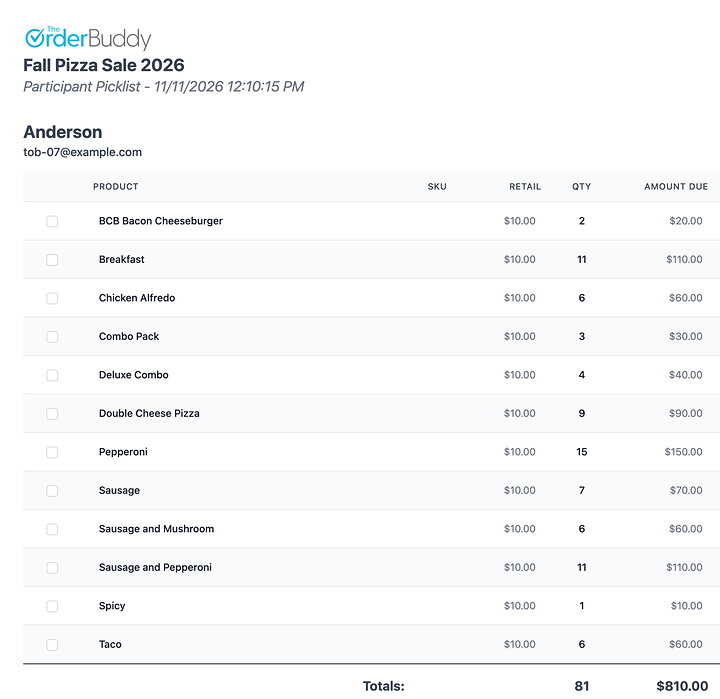
Print it and hand a page to each volunteer. Every family gets its own block: each product, how many, a box to tick as it goes in the pile, and the family’s total. Sorting stops being a puzzle and turns into counting.
Families can pull up their own picklist too, so they know exactly what to take home. They see the pickup details you set, and after pickup, each family has a Customer Delivery sheet for getting orders to their customers.
And every order picked up puts a customer on next year’s list, so next year you can see exactly who to ask again.
What it won’t do is run a check-in line or book pickup time slots. Print the picklists and bring a pen.
Want to see it on your own sale? , or read straight answers on how it works.
Your checklist
- The four answers from your supplier, the week before
- Pickup window (or two days) and place announced
- Freezer space or coolers lined up, if it’s frozen
- Cases counted with the driver
- Unpaid orders collected at the table
- No-shows texted; leftovers have a home and a deadline
All nine steps
- 1.Set three dates, and treat the close as a hard stop
- 2.Pick one coordinator, and make it obvious who it is
- 3.Give every seller a goal they can see
- 4.Kick off with one meeting and one link
- 5.Decide how you’ll take payment, and say it once
- 6.Check in at the halfway mark
- 7.Close on time and send one clean supplier order
- 8.Make pickup day boring
- 9.Wrap up and hand next year a head start