
The short version
- Close the books within a week, and chase anything unpaid now.
- Write down what you learned while you still remember.
- Keep the customer list, and hand the customers families leave behind to families who are just starting out.
Why next year starts from scratch
Next August, someone sits down to plan and asks what the group sold last year. Nobody knows. It’s in a spreadsheet on someone’s laptop, or in the recycling. A family who sold to forty homes moved on, and those customers were left behind, waiting for a knock that never comes. So everyone starts from a blank form, and the sale shrinks a little. Again.
What to do
- 1.Close the books within a week. Total sales, what the supplier charged, what you raised, and what’s still unpaid.
- 2.Chase unpaid orders now. A friendly text this week works. In March it’s awkward for everyone, and the board gets a total that isn’t real.
- 3.Say thank you. Each seller texts their customers. Thank volunteers by name, and send your supplier a note.
- 4.Write the handoff note. Write down what dates worked, who to call at the supplier, when the order is due, what sold, what didn’t, and what you’d change. Half a page, this week.
- 5.Keep the customer list, for the sale only. Don’t use it for anything else or share it.
- 6.Hand off the customers families leave behind. Seniors graduate and families move, but their customers still want popcorn. Give them to a family just starting out, close by. (Here’s how.)
Copy this
For an unpaid order
Hi [name], thanks again for supporting [group]! I have your [product] order ([amount]) as still unpaid. You can pay by [how]. Let me know if I’ve got that wrong!
From a seller to their customers
Thank you so much for buying [product] from me! You helped [group] raise [amount] for [what it pays for]. I’ll check in again next [season].
For the board
The [product] sale raised [amount] on [total sales] in sales, from [number] households and [number] sellers. That’s [up/down] [amount] from last year. [Number] orders ([amount]) are still unpaid, and we’re following up.
A quick example
The week after pickup, a Cub Scout pack chased its last $300 of unpaid popcorn orders. They got all but $24. Six families were moving on from the pack, and they had sold to 27 homes. So the leader handed those 27 to families just starting out. Her half page of notes said “order more caramel corn” and “count the cases at pickup.”
How The Order Buddy handles it
Most groups type the paper forms into a spreadsheet. It makes sense today, on one person’s laptop. Seven months from now it takes some remembering, if that person is even still in charge. With The Order Buddy, it’s all in one place for whoever runs the next sale. Every order shows if it’s been paid, so each family’s unpaid list is right on their delivery sheet.
Customers carry over on their own. When the next sale opens, each family’s Unsold Customers list already has the people they sold to who haven’t ordered yet. Each one has an Add order button. When a family moves on, you hand their customers to a family just starting out (how assigning works).
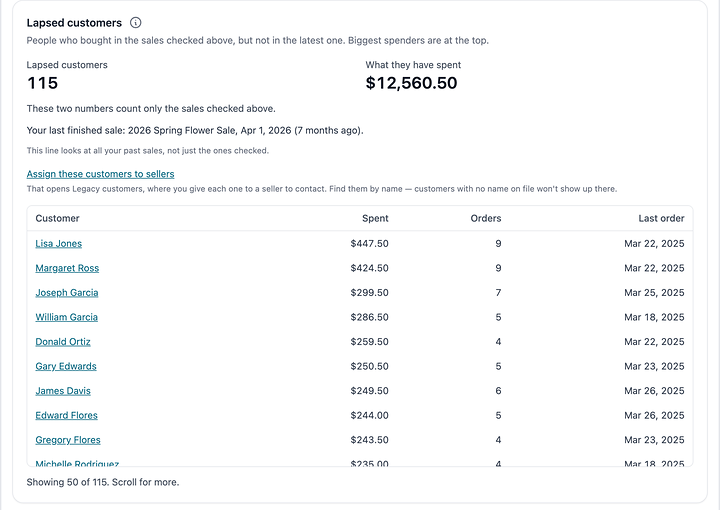
After the sale, Insights shows how it stacks up against your past sales: sales, sellers, homes and orders. It also lists your lapsed customers, people who bought before but not this time, biggest spenders first. Next year’s sale can start as a copy of this one, with the same products and prices and a list of what changed.
What it won’t do is move a family’s whole list in one go. You hand off one customer at a time. And every family signs up again for each new sale.
Want to see it on your own sale? , or read straight answers on how it works.
Your checklist
- Books closed: sales, supplier cost, what you raised
- Unpaid orders chased this week
- Thank-yous sent
- Handoff note written
- Customer list kept, for the sale only
- The customers families leave behind, handed off
All nine steps
- 1.Set three dates, and treat the close as a hard stop
- 2.Pick one coordinator, and make it obvious who it is
- 3.Give every seller a goal they can see
- 4.Kick off with one meeting and one link
- 5.Decide how you’ll take payment, and say it once
- 6.Check in at the halfway mark
- 7.Close on time and send one clean supplier order
- 8.Make pickup day boring
- 9.Wrap up and hand next year a head start